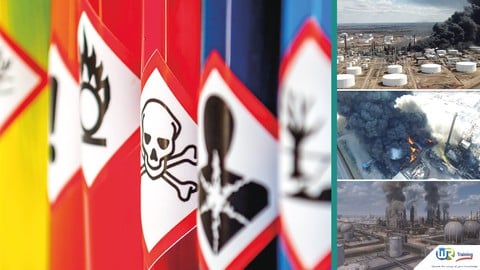
Do you handle harmful chemicals during your work ? If so, we strongly recommend you take the time to watch this course carefully.
The purpose of this course is to educate you about the potentially hazardous chemicals in your facility and how to minimize exposure. It provides valuable information on identifying risks associated with hazardous chemicals, minimizing exposure, labeling, inventory requirements, and the correct procedures to respond to emergency situations, involving incident events such as:
-
chemical spills
-
BLEVEs’ (Boiling Liquid Expanding Vapor Explosion)
-
VCEs’ (Vapor Cloud Explosion).
The usefulness of this course is not limited to operating people, there are many useful applications for the maintenance, design and construction of facilities.
The hazardous substances covered in this course include:
-
Hydrogen sulphide (H2S)
-
Nitrogen (N2)
-
Hydrogen fluoride (HF)
-
Anhydrous ammonia (NH3)
-
Chlorine (Cl2)
-
Caustic soda (NaOH)
-
Acids
-
Liquefied Petroleum Gas (LPG)
-
…
In addition, numerous real-world accidents from the Oil & Gas and chemical industries are presented and discussed in an easy-to-understand format using 3D animations.
We are confident that this valuable course will help you contribute to the safety of your facility, your fellow workers and yourself.
So please take the time to watch this course carefully and feel free to share your experience with others since this is one of the most effective means of communicating lessons learned and avoiding unnecessary incidents in the future.
Thank you for your interest in our online courses. Enjoy this valuable course and stay safe out there.
WR Training
Spread the wings of your knowledge
–
NOTES
-
This online course is intended as a safety supplement to your operator training courses, operating manuals, and operating procedures. It should not be treated as a substitute for them.
-
It is provided to help you better understand the ‘why’ of safe operating practices and procedures in your plants.
-
The advice in this course is a matter of opinion only and should not be construed as a representation or statement of any kind as to the effect of following such advice and no responsibility for the use of it can be assumed by WR Training.